
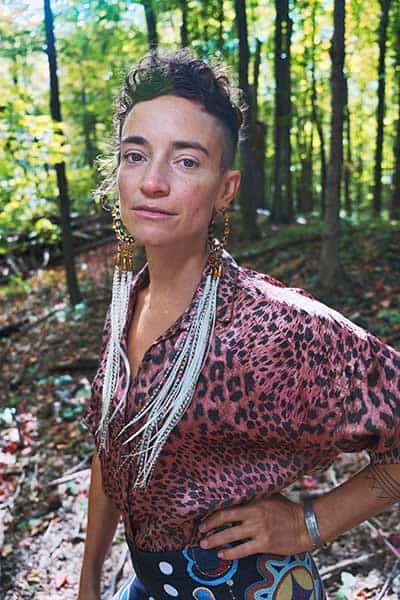
Moe Clark

Portrait of poet Moe Clark, OmniVerse Project contributor.

zâpihtawikosisâniskwêw (Métis / nêhiyaw / Norwegian / French / British) multidisciplinary artist Moe Clark is a 2Spirit singing thunderbird. She fuses together vocal improvisation with multilingual lyricism to create meaning that is rooted in personal legacy, ancestral memory and embodied knowledge. Originally from the prairies in Treaty 7, she’s called tio’tiá:ke (Montreal) home for over a decade. Her work as an artist, educator and activist aims to remember and reconnect belonging to territories of land, body and voice through creative continuums of indigenous language immersion, ceremonial practice and song creation.

Apart from performance, Moe facilitates creative workshops with indigenous youth in lockdown facilities and remote communities and she is a collaborator with Land as Our Teacher project that bridges urban indigenous youth with cultural teachers and inclusive land-based education. In 2016 Moe launched nistamîkwan: a transformational indigenous arts organization with an emphasis on intercultural, interdisciplinary and intergenerational collaboration. The land-based nêhiyawêwin (Cree language) songwriting project with artists and knowledge keepers Cheryl L’Hirondelle and Joseph Naytowhow will soon be released in a full-length album. Moe has been featured around the world at the UBUD Writers & Readers Festival (ID), Origins Festival in London (UK), Maelström Poetry Festival (BE) and Skábmagovat Festival in Sapmi (FI).

Explore Moe Clark’s history, craft, performance insights, and original poetry below.

History – kinship, orality, + the in-between:

There is no one beginning, middle or end.
All I know is there must have been a spark, a flame, a rattle shaken in the dark, loosening the seed thoughts of creation to call the voices in.

            and the beat goes on
            resonance rotates
            song cycles loop
            creation is continuous

Late mosôm, Oji-Cree Elder and knowledge keeper Bob Smoker spoke about how sound was born, from a dark void, a hollow black place. Rising up from a deep down in the inner core of existence, a resounding call came out into the world, creating an outer voice.

            inner voice
            from dark place
            outer voice
            reverberates

What I’d like to draw attention to is the in-between voice, straddling thresholds from inside-out and transforming states of being in-between dimensions. As an apihtawikosisân tastawayihk-iyiniw, Métis in-between (or Two-Spirit/2S) person, I consider much of what I do to be about finding balance in the in-between. Instead of positioning myself on the edge of something binary, I situate myself as one of the middle people. In much the same way, I consider spoken word an in-between medium, one that defies any singular classification, but has occupied an invaluable space in the literary canon for centuries. This place is one that speaks, sings and chants from the in-between

            it doesn’t only live on the page,
            it lives inside and outside the body;
            it lives in-between bodies…
            of people, bodies of land, of water and sky;
            it lives in the minds and imaginations of many;
            it lives in-between the page and the stage,
            the lyric and the song;
            it lives in-between the breath and beat;
            the campfire and the street;
            it lives in-between the child and the elder;
            the story and the teller;
            it lives in-between temporalities and dreams…

What matters here, is that spoken word LIVES.

Spoken word is a living, breathing, interconnected series of relationships, which stimulate our spirits, minds, bodies and hearts long after words have been spoken. Spoken word animates invisible worlds, the resonance of words spoken feasts presences beyond our control. We can conjure the past in the present by speaking a single name, and we can dream up new futures by rearranging the story and giving voice to our pain. Even when it’s not recorded, spoken word makes an imprint, informing how we listen, understand, and make sense of the world(s).

My first memory of witnessing live spoken word performance was listening to Sheri-D Wilson perform alongside upright bassist John Hyde, in an expressive typography class at art school. I didn’t quite know what hit me. Sheri-D summoned something bigger than all of us in the room, with a precision of tone and beat, and a flail of tongue and cheek, she had me at the edge of myself. Sure, I’d heard about the beats, but I’d never heard one live. Sheri-D drew from jazz and improvisation, prayer and incantation, storytelling her way through feminist, eco-centric, mystic, and profane poetics. She became a mentor, inviting me to poet parties, to perform on the emerging artists spoken word stage at The Calgary Festival of Spoken Word, and in 2008, to launch my first spoken word album at the festival. I was designing the festival posters for a few years, while attending art school full time. This was my first taste of intergenerational mentorship, built from a creative resonance with poetry and community, and at the time, I was quite oblivious to just how influential this mentorship was for me.

Sheri-D, kinanâskomitin – I thank you

            next beat
            sage brush
            cypress hills
            wandering wally
            métis elder
            recites the final trial
            of louis riel
            cultural beckoning
            historical reckoning
            education imprint

When I started reconnecting with my Métis lineage through community connection, I began learning from Indigenous poets and storytellers able to weave cosmology, language, humour and truth together in stories to inspire empathy, humility and courage. On a trip to the Cypress Hills in my early twenties, I met Métis storyteller Wally Gariepy, who shares one of my Métis family namesakes. Seated behind a stump on a hill above Elkwater Lake, Wally recited word for word, line for line, the entire final trial of Louis Riel. His conviction, integrity and mastery of language and tone, made an imprint on my memory no textbook ever could. These mentorships continued, and through creative kinship with nêhiyaw, half-breed knowledge keeper and artist, Cheryl L’Hirondelle and nêhiyaw knowledge keeper and storyteller, Joseph Naytowhow, I learned how to weave nêhiyawêwin (Plains Cree language) with land-based practices to create song. Writing from kiyokêwin (visiting/ conversations) with one another while walking on the land, attending ceremony, or sitting around a fire, we’ve collaboratively created almost a dozen songs in nêhiyawêwin.

            maarsii Wally, Cheryl & Joseph

**

I remember watching Blackfoot poet Zaccheus Jackson perform in a Halifax pub at the 2007 Canadian Festival of Spoken Word Poetry (and slam). There was a palpable upsurge from the earth beneath us, as if he’d released a spell and awakened something needing to come home. His spitfire tongue, captivating gaze, and heavy dose of raucous metaphors, conjured something beyond us.

            hay hay Zaccheus

The first time I saw D’Bi Young Anitafrika perform “BloodClaat” live at the Art Gallery of Calgary, I felt layers of societal stigma, body and blood shame, dissolve. D’Bi’s raw refusals, naming the oppressor, and embodiment of resistance through repetition in dub poetry, gave permission to say the unspeakable, to step out of uncomfortable silence and take up space.

            thank you D’Bi

On separate occasions I’ve shared the stage with Innu poet and Elder, Josephine Bacon; Inuk throat singer + poet, Tanya Tagaq; Mississauga Nishnaabeg writer and poet, Leanne Betasamosake Simpson; Djapu writer and slam champion, Melanie Mununggurr Williams, and spoken word poet and whirling dervish, Tawhida Tanya Evanson, and each time, I’ve been in the presence of warriors. These story and sound shape shifters are healing generations, opening doorways for future womxn, femme and racialized artists to lick the inherited wounds clean with beauty and boldness.

            kinanâskomitinâwaw

This cycle of orality wouldn’t be complete if I didn’t acknowledge my family, who fostered a love of campfire songs and storytelling under Milky Way skies. To my great grannie Mabel who recounted stories of rebellion and sacrifice, living on the edge of trouble and surviving two world wars, and to my grandmother Norma whose legendary stories opened up a tender space in our relationship, where I actually felt we could meet one another.

            tusen takk

Craft & Writing – Dreams, Landing, kiyokêwin

I keep a dream journal next to my bed. When I wake up, I try to write down my dreams before anything else. Sometimes they spill out of my head before I’ve even opened up my eyes. Sometimes the images carry me in a stream of conscience while my subconscious plays guide. I’ve sat and shared dreams in a circle of womxn, and we’ve found layers of alignment in the patterns that emerge. Somehow this process feels like it awakens a space of prayer and therapy, while allowing us to mask our conscious vulnerabilities with sublime insights and imagery. I’ve taken dreams and turned them inside out to become poetry. One image, one phrase that feels necessary, can lead writing into completely new territories. Some call this the ghost line, but I like to think of it as the dream line. I try not to edit. Just put down all the details. The magic is in the details, in the textures, colours, smells, and movements. I deep dive into the senses, until meaning becomes senseless and logic doesn’t reign.

Often I light a smudge of sage or sweetgrass, centre myself into breath, let the smoke fill my body, clear my thoughts and spirit. Then I invite my guides, ancestors, and helpers to join me. Perhaps I light a candle, or take a walk outside to sit by a tree, and I’ll enter a space of prayer. Call it prayer, call it meditation, call it a moment to pause, and remember there is something much greater at play here. This is an activation of that which is beyond me, an invitation for my intuition to witness, listen, and then speak. I’ll take out my phone, use my voice notes app, and just let the language come forth. Perhaps I’ll repeat words, stutter them into syllables, or even draw from sounds, slowly emerging from something I feel or see, which later inform poetry. Sometimes I’ll grab my drum, let the rhythm and heartbeat of the elk skin reverberate my being to inspire language and melody. I’m always coming back into awareness that poetry is alive in everything, and that most “things” which surround us, are animate.

Craft & Writing Prompt

I would like to offer a small meditation and writing from the land exercise, one that I use often when I am trying to create a new piece. Inspired by Pauline Oliveros’s sonic meditations, here is a step-by-step practice:

Go outside.
Go to the forest, find yourself at the edge of a body of water, or simply, at the foot of a tree.
If you can, put your naked feet on the earth.
let kakawinaw askiy (mother earth) whisper into the base of your feet.
Breathe. Listen.
Draw your focus on one thing directly across from you,
soften your gaze and let your peripheral vision
and awareness become all encompassing
take in your surroundings
notice the wind on your cheeks
what heat, vibrations or textures can you feel
beneath or above you?
let your breath deepen
does the air smell fresh, dry, sweet?
let your breath and body blend with your surroundings
be transfixed by the ecosystem that holds you
and the energies that move between
you and what you see, feel, smell, hear and touch.

begin humming, lips closed, toning on a single note.
open the sound and move through different vowel shapes and sounds.
explore how each sound feels inside your mouth,
how it changes the shape of your tongue, the stretch of your lips.
slide the tone up and down.
soften your neck and shoulders

now, focus on something specific that you can see.
a horizon line in the distance, a texture in the tree bark, a stone in the river.
trace the contours of your vision with sound.
allow the voice to rise and fall, to crack, growl and resound.
feel into a response, an echo, a reverberation.
once you’ve completed the phrase, the tracing,
drop into silence.
what is alive and what has come to life?
listen.
what changes do you feel in yourself?
feel.
what shifts do you notice in the landscape and bodies around you?
sense.
grab a pen and paper, begin writing down everything you notice.
move through these images, senses and discoveries in a free-write.
don’t judge or edit.
allow the direct connection, direct channel to the world around
& within you to emerge from your imagination.

When I think of spoken word, I think of all the stories never written, but those transmitted by relatives around a campfire or across at the kitchen table, as necessary keys for survival. Imbedded in these stories, are recipes for harvesting and making medicines, manifestos for starting a revolution, for babycatching, for locating caches of food in the winter months. As Métis matriarch and acclaimed writer of “Half Breed,” Maria Campbell teaches the ongoing importance of kiyokêwin, the act of visiting or kitchen table talks amongst kin, as being an essential place for knowledge transmission, subversion, and resistance. Never underestimate the power of what can be shared and learned in these moments of exchange. Not everything needs to be written in order to take root.

Performance

            resonance between bodies
            visible and invisible
            creating points of relation
            integration, syncopation
            call and response

I often say my first language was song. Before I could really express myself and found that I had something important to say, I had a deep relationship to song, to sounding with my voice, acknowledging relationships that made me feel alive. I would spend hours in the woods, among the trees and plants, drawing creatures, while singing and writing poetry for the land. My family and I would camp each summer in Cypress Hills Provincial Park, and each night we’d spend hours gathered around a campfire singing and telling stories. When I recall these memories, I feel a sense of home, of continuity in my growth as an artist, and a point of origin that helps me establish a root system to return to when I question how I got here or where I’m going. I remember performing “Mortimer Be Quiet” to my entire elementary school at about 10 years of age, and witnessing the power of call and response with my childhood peers.

Later on, I learned call and response as an Indigenous methodology for transmission of song, story, and knowledge between members of family, nations and communities. Cradled in the mountains at the Banff Centre I remember learning the Strong Woman’s song with a group of Indigenous vocalists. Lheidli T’enneh, Cree and Secwépemc artist, Kim Gouchie, taught us her version of the song through call and response. In another moment, Cheryl L’Hirondelle taught me how to listen and watch, as if a bird eating from a mother’s mouth, and take the shapes of the sounds from her lips into mine, so I would learn and remember correctly the vocables of the drum song she was teaching me. The song was Waniska, a traditional Cree sunrise song that would have been sung daily by a morning crier to wake up camp. Oral traditions play many roles, and sunrise songs predate cell phones as the original community alarm clock. After many days of practicing Waniska, I finally got it right. I am grateful to have learned this way, which has inspired how I draw from shapes, sounds, and movements in my environment to make sonic landscapes within which poetry can come to life.

Returning to the concept of tastawayihk-iyiniw, I would also say I’m an in-between performer. Much of the performance work I do is intersectional, drawing from a hybridization of technology and tradition, song and spoken word, and integration of languages always spoken and those being reclaimed. When engaging technology into my practice of spoken word, I am opening up portals for connection with kinships across dimensions and temporalities. 2S Métis and Nishnaabe writer, Kai Pyle, refers to this as trans-temporal kinship. Pyle asks us to question whom our 2S ancestors were/are and to utilize the tools we have been given, to make and maintain connection with these ancestors. As a tastawayihk-iyiniw creator, it is important for me to acknowledge the bridge between technologies of the so-called past, with present day innovations; in the tools I use and the way I use them. My poetry and song creations hope to uplift kinships across dimensions and timelines, in creative and accessible ways.

I first discovered the looping pedal when I was in my early twenties. I remember turning it on and having no clue what I was getting into. Three hours later, I realized I had found my muse. At the time, there weren’t many others using looping pedals. Alexis O’Hara, Ian Ferrier, and Mihirangi were the first artists I saw using them with spoken word and voice. For me, looping pedal opened up another dimension, a portal that helped me lift up my voice as a long-time singer, while leaving space for spoken word to emerge and fill the space between. This is when my spoken word performance transformed. I was able to move fluidly between song and spoken word, creating hooks and refrains that rang out across the room. Here, play took on the form of multi-layered vocal soundscapes, which danced and stuttered their way beneath and through my poetry. These pieces also informed the musical backbone when I created my first spoken word album. I found my place of marrying song with spoken word.

To move deeper in the discussion of performance, I want to say there is no such thing as a bad or ugly sound. When I first started using a looping pedal I was quite fresh to the sound of Inuit throat singing. I’ve since shared the stage with a myriad of amazing Inuit throat singers, including Tanya Tagaq, Nina Segalowitz, Sylvial Cloutier, Hovak Johnson, Nancy Saunders, among others. What I’ve learned from these powerful Inuit women is that the sounds our bodies and spirits can make are limitless. These song forms and patterns date back thousands of years, before looping pedals or microphones were even thought of. The repetition and subtle variations in voice are indications of different qualities or textures of landscape, animal kinships, of love. I’m not a throat singer, but I reference this form of song to say that the sounds we make and things we say that are the most compelling, are often the most confronting and perhaps “strange” to the trained Western ear. More often than not, these are sounds that reach the deepest when they are made and heard.

**Take a risk, and make sounds that you consider to be beyond the edge of your comfort zone. Go near rushing, in the shower, in your car or on your bike, and scream, wail, growl, groan, yodel. See how many times you can repeat and transform that sound, until it becomes boring for you. Don’t hurt yourself. Work at a pace that your body can handle, and drink plenty of water before and after. Breathe from your belly and relax your body.

Looping pedal offers an accompanying voice, which calls on ancestral voices, circle singing, sweat lodge songs, choral singing, and other animacies of the natural world. The repetition of sounds and layering syncopates heartbeats with earth-beats, cosmic utterances with guttural frequencies, providing a soundscape for language and poetry to land, walk through and live inside. When you mix these possibilities for voice with pitch shifting, delay, reverberation, splicing, and amplification, new vocal personifications that sound otherworldly or beyond-human, are born. I’ve seen Alexis O’Hara, a pioneer in the looping pedal and experimental vocal effects world, transport her voice into outer space in one moment, then pitch shift and distort her voice into a demonic being the next. O’Hara rides these lines often, and with much humour and satire, never letting the machine overpower her own will as a performer, but using technology to her advantage as a means of amplifying her already commanding presence. Through vocal transformations and layering we have the ability to embody through sound what we can’t always embody in language.

In the last ten years, I’ve also been exploring moving between languages, and how far the in-between sounds of language can take me. Every weekend I meet with a community of nêhiyawêwin learners online, cup of coffee in our hands, to kiyokêwin (visit among kin) and practice nêhiyawêwin. Throughout this process, I’ve been taking up learning one of the foundational languages of Michif (a hybrid language created and spoken by the Métis people, one dialect of which is a combination of Cree verbs and French nouns). What began for me as a gateway to learning Michif, continues to grow and inform my mitêyiniy (tongue) and my mitêh (heart). There is no surprise that the word for heart and tongue have the same root in the language. Each word I learn in the language brings my tongue that much closer to voicing the words of my heart. As Joseph Naytowhow reminds, “use your words,” no matter how many or how few you know. Woodland Cree language teacher, Charlotte Ross shares “we need the spirit of the language to know it’s safe to be spoken.” I smudge when I write and sing in language, honouring that which is being activated through the voice. Leo Yahyahkeekoot, nêhiyawêwin syllabics teacher, shares how each sound in the language has an origin, is a spirit marker, and when voiced together, they call on relationships that connect across space and time, and between dimensions.

There are many artists who are at the forefront of a global Indigenous language resurgence. They are keeping Indigenous languages alive with animated and integrated poiesis, in the worlds of knowledge keeping, creative refusal and remembering. Their voices are calling backwards into the future in a reciprocal reimagining to mend the ruptures caused by colonial violence and forced silence. When we engage poetry as political act; our bodies are resonant continuums of ancestral lineages; and when we voice our land-based languages we are catalysing Indigenous futurity as land-back. To name a few I honour the contributions of Oji-Cree 2S writer and poet Joshua Whitehead, nêhiyaw writer and poet, Louise Bernice Halfe Sky Dancer, nêhiyaw knowledge keeper and storyteller Joseph Naytowhow, Mississauga Nishnaabeg writer and poet, Leanne Betasamosake Simpson, and Kanaka Maoli queer spoken word poet and activist, Jamaica Heolimeleikalani Osorio, among others.

            kinanâskomitinâwaw

**