
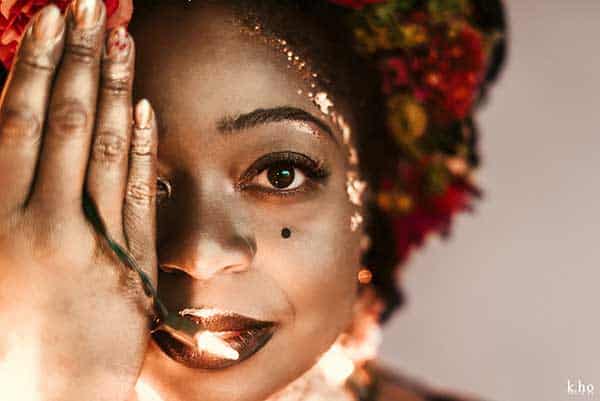
Jillian Christmas is an artist, creative facilitator, curator, consultant, and advocate in the arts community. She is the long-time spoken word curator of the Vancouver Writers Fest, and former artistic director of Verses Festival of Words. Utilizing an anti-oppressive lens, Jillian has performed and facilitated workshops across North America. She is the author of The Gospel of Breaking (Arsenal Pulp Press 2020), and the forthcoming children’s book, The Magic Shell (Flamingo Rampant Press 2021). She lives on the unceded territories of the Squamish, Tsleil-Waututh and Musqueam people (Vancouver, BC.)
History
My work gathers itself around myriad themes including but not limited to family story, ancestral reconnection, longing, loss, revolutionary love, social observation, Blackness, Queerness and collective liberation. In order to be expansive, my work demands that both it and I be rooted deeply in knowledge of self. I aim to write and rewrite the stories that live in my body and my bloodline, seeking within them and within myself the tools for healing, dedication to joy, cultural reclamation, and connection. In my exploration of each of these subjects I focus my lens on authenticity, working to strip away from myself that which would separate me from my own truth, and by extension, the truth of others.
This rooting demands that there are some parts of my process that are not hidden, but held sacred. The time spent at my altar communing with the truth seekers in my lineage, the untangling of some personal thread or another, left unspoken on the stage, but declared urgent by the pages of my notebook. The quiet meditation and the long walks that stir up, like a wind, that which might otherwise go undisturbed. All of it is fuel for the process, the process being: a revolutionary fortification and celebration of my own creative spirit, my queer black, neurodivergent glorious soul, my free and expanding connection to kin of many sorts, untethered from the wrecks of colonial narrative, or need. I am a seeker of many answers and more questions, writing into the future a salve for the past, pulling from the past a link to the present, and planting in the present an abiding hope for our collective futures.
This work demands that we confront an ever-shifting volume of questions. Many of which we may never find answered outside of the realms of our own imaginations. What do you know of your own story? What do I know of mine? Which pieces are too valuable, too precious to not be shared into the collective, contributing to a deeper knowledge of self, community, and humanity as a whole? Which pieces are not ours to share? And which pieces are ours alone? Questions of this sort are not to be consumed without some container of safety, lest the floor from beneath us open like a trap-door ready to consume the writer themself. I offer to you that there are endless ways to create such containers, infinite in fact, many of which I will never encounter. Whether your practice is to decompress with a peer, or mentor, or to tease out the knots of these questions with a counsellor; whether you are called to move the force of these questions through your body by dancing, or clowning, I urge you to find an outlet as a companion to your page. A multitude of mechanisms, even, with which to clear the mind and heart of the churning queries we desire to explore and distill.
What lineages do you come from? Who do you consider an ancestor? Who has loved you into existence? There is more to find in our collective histories, than trauma. If we are to trust in the certainty of intergenerational harms, we must also affirm the processes of intergenerational health and healing
modalities. The ancestral medicine of collective song. The magic of slow practices like sewing and braiding. None of these are frivolous companions to the practice of writing and performing. To know and share our stories is to embrace the complexity of them. Tell us how you hurt, and tell us how you survive. This is a legacy worth contributing to. An acknowledgement of what was, what is, and of what is possible.
History Prompt: Nurture you, Nurture me
What you will need: A quiet room with light, if you have that available to you, whatever writing utensils you like best, a glass of water.
Think about a moment (real or imagined) when you felt deeply nurtured and cared for. Imagine or recall the details. Write uninterrupted for ten minutes. Tell the reader the finest features you can conjure of what and who was present. Show us the size and shape of the location, describe the nuances of smell, taste, temperature, facial expression, who was there, and how did their presence contribute to your experience? If this memory were a colour, tell us the name of the shade, were you grounded by the heaviness of cobalt, or floating in a dream of robin’s egg blues? What was the song playing quietly on the radio? Sing me the lyrics.
Craft & Writing
I remember as a young writer, being disquieted by the idea that there was “nothing new under the sun” – as my teachers used to say. There was something unsettling to me in the idea that we, as artists and humans, are destined to repeat what has already been created or invented. Though I was well aware that only I could offer my perspective on any given topic, I wanted something more radical than that, something truly unique to offer the world. As my idea of myself as an artist grew, that feeling of being stuck in a predetermined groove was one of the first blocks I needed to address. I was lucky that when I found myself finally unstuck from a dead-end job and carried across the country to a new home on the west coast, the first people I found myself surrounded by were a ragtag group of writers, musicians, storytellers and clowns focused deeply on the magic of improvisation, collaboration and a shared mission to inspire each other toward our best work. It was, perhaps, our own little renaissance. And there, I fell past my own sense of fear and inhibition, deeply in love with the art of collaboration. For me collaboration became the golden ticket that could rescue any of us from the predictability of our own narratives and thrust us into an incredible moment where the individual players create infinite possibilities for process and outcome. An ongoing game of “Yes…and…”, where none of us know the end results before the game is done. This excites me, the possibility, if only for a moment, of being so alive together, so tangled in each other’s creative energy and collective experience, that it could never be duplicated. How precious is it to be in the presence of that moment?! The opportunities for learning something new in a cypher, or a jam are endless, and the wonderful discoveries that erupt from a shared creative session delight me and encourage me to dig to my most unknown depths and offer the best of myself to the cause.
Craft & Writing Prompt: Braiding Us Back Together
What you will need: A quiet room with light, if you have that available to you, whatever writing utensils you like best, a glass of water.
This is a partnered (or collective) writing exercise. Each partner is asked to write toward the prompt individually. Once the writing is finished selections from each contributor will be braided together to create the complete poem. The individual writings can also stand alone – a wealth of stories.
Step one:
For fifteen minutes, write about a moment in your life that you wish had ended differently. This could be as small as an argument with a stranger, to the loss of something or someone dear to you. This could be a moment of injury, or an embarrassing moment you wish to re-write. Write about this situation but choose an ending that offers you new possibilities. Maybe this time you have the perfect come-back for that bully. Maybe this time you walked away together instead of apart.
Step two:
Once the writing is complete, review the individual writings. Each collaborator is tasked with selecting from their own writing ten lines which speak to the depth of the experience. Do not be afraid of the specificity of language. Select the lines that resonate most with you emotionally, then show these lines to the other contributor(s).
Step three:
Once you have offered the ten selected lines to your writing partner(s) for review, allow them to select for themselves, eight of the ten lines you have offered up. Selections can be based on what compels them, stirs emotions, feels relatable, or stands out as impactful.
Step four:
In whatever order best suits the rhythm and shape of the final piece as well as the efficacy of the contributed lines, braid together the selected eight lines from each contributor, smoothing out any odd tense or pronouns that remain from the first draft, until the final piece is crafted. This final piece can be read as a unified story, a collection of vignettes, a list, or even a conversation. The possibilities are endless.
Step five:
Read the final piece aloud. Utilize as many voices as best serve the strength of the piece.
Step six:
If you wish to share, publish or perform the piece publicly, confirm consent with your collaborator. You do not need permission to edit or share the contributions that you created individually.
Performance
When I find myself drifting in the soup of humanity that poetry tends to evoke, I often find it helpful to create a container best suited to the work I hope to present. Some form of auditory (or visual) environment for the words to step into. Here I often build from melody, to percussion, layering harmonies, field recordings, or plucked strings to support the story that is being told in lyric. I often utilize instrumentation like an emotional map, or landmark to return to when an image drifts us in one direction or another. A mechanism to hold all of the pieces together so that the imagination can go wandering.
One of the greatest joys for me comes once I think the piece is done, that is when I really get to play with it, stretch it, and turn it upside down in search of new meaning found in a pause, intonation, repetition, or extended breath. The explorations that can exist in any given piece can be endless, but each time I am able to bring it to the stage, the piece lives anew in that iteration, supported by the collaborative energy of the audience, the feedback they may not even realize they are offering with a laugh, or a grimace. I am constantly reminded in these moments, of the infinite ways we are afforded to ignite story in each other, to reveal a little more about our shared humanity, and to bask in the celebration of a vibrant and persistent artistic community.
What performance skills can you utilize to support the work that you have created? Perhaps there is a scrap of song written but unfinished that begs to be nested in the arms of a poem. Does the tone match what the poem is feeling? Does the melody add to, or muddy your meaning? What facial expressions do you want to use to highlight the emotion of the piece? Are you willing to play with backdrops? Lighting? Ambient sound? Are you a visual artist whose graphics or projections could illustrate even more possibility in the piece you have created? Could you experiment with volume, tone and intonation? Roaming eye contact, or a fixed gaze? Can you wrestle with the craft of restraint? What are the capacities of our bodies to move the story? What tools can you cleverly select to light this story from within? What are the limitations of our imaginations?
Performance Prompt: Story is a Living Thing
What you will need: A piece of writing from the exercises above or any other piece of writing you wish to explore, A telephone or in person visit with a trusted peer or friend.
This is a partnered exercise of community building. While there is no requirement that we write with the intention that a piece will be shared, I recall learning early in my love of writing, that a poem truly comes to life once it is read aloud. I would add to this that the life of any writer is greatly enriched by membership in a community of writers and lovers of art who can offer us a reflection of what we have created as well as an interpretation and projection of what was received by the listener.
Call up an old friend, or perhaps record a video of yourself delivering the piece, share it with a trusted friend, peer or mentor. Ask for whatever feedback you desire, or simply ask to be witnessed. You can be a witness in turn. Offer your writing the gift of being alive in the world and see what is returned to you. Imagine what thoughts or conversations you might spark. Envision the chain of connections that might follow. Perhaps your courage in reading your piece will spark a desire for your listener to also be heard. Perhaps it will spawn a group of sharers who can depend on each other for thoughtful critique and collective celebration. Seed the community you want to exist in. Build the connections you seek. Fill the air around you with poetry. Whatever form you choose, Your final task is to share.