
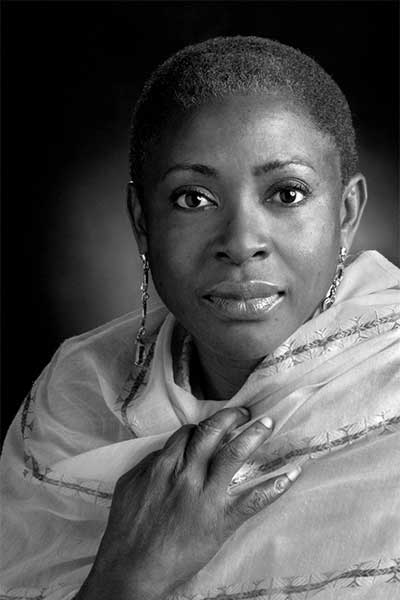
Dr. Afua Cooper is a multidisciplinary scholar and artist. Her contribution to society includes the literary arts, history, humanities, education, and human and civil rights. Her twelve books range across such genres as history, poetry, fiction, and children’s literature. Dr. Cooper served as the Poet Laureate of Halifax Regional Municipality for the term 2018-2020.
Explore Afua Cooper’s history, creative craft, performance insights, and original poetry below.
History
Afua Cooper.
I migrated to Canada over 40 years ago from Jamaica. I arrived in winter at the Pearson Airport, Toronto. As I stepped outside the airport to be welcomed by my older sister who had been living in Canada for eight years, my nose began to bleed. Not a very auspicious way to begin a new life. I was supposed to be on a two-week visit, and I ended up staying my whole life.
The culture shock was real. Living in an apartment in concrete jungle in Mississauga, the cold, the all-white population, the difference in social culture, the outright and blatant racism (I applied for a job as a waitress and was told to my face, they didn’t not want Jamaicans), sent me into a depression.
Writing, especially poetry, aided me to navigate this new life. I wrote and wrote, often inspired by Reggae music. I would play music in my apartment and danced and danced. I wrote and wrote. Then I began performing my work at venues mainly in Toronto. Travelling time from Mississauga to Toronto, on public transit took an hour-and-a half. I performed at such places as Strictly Ital, The Trojan Horse, El Mocambo, The Bamboo Club, and Danforth Music Centre. I performed at various community and university events, festival, protests and demonstrations. Later, I would travel to most Canadian provinces and outside of the country to read from my work, give lectures, or poetry performances. In the early years of my poetry performances, I worked with two bands, Gayap Rhythm Drummers, a percussion group, and Rebel Radio. In these groups, I not only performed poetry, but I also sang as well.
In the years before emigrating from Jamaica, dub poetry had just begun to come into its own as a literary and musical form. Dub poetry was birthed by Reggae music. The Dub fuses Reggae Rhythms (called riddim), and privileges the (kettle) drum and bass, various forms of African drums, and other instruments. Ultimately, the (poet’s) voice commands and rides all these riddims.
For two years I lived in the hills of St. James with the now celebrated dub poet Mutabaruka, his wife Yvonne, and their baby Ishi. Muta and I often wrote together and began thinking of co-writing a book of dub poetry. The book never materialized but I did record on WomanTalk, an album Muta produced of the women poets. In the hills, we were committed to living the ital life, farming, and working toward self-sufficiency. Another pioneering Dub poet Oku Onoura was also my close friend and literary mentor. In my migration to Canada, I brought the artform with me and hence became one of the founders of this poetic form in Canada.
I have published six books of poetry; the last one Black Matters (2020) won the J.M. Abrahams Atlantic Poetry Prize. I am also the winner of the Portia White Award, Nova Scotia’s highest prize for artistic excellence. My poems have been published in numerous anthologies in several languages and have been recorded on four CDs. I am an internationally recognized poet and spoken word artist.
Craft & Writing
How is the Writing Made?
Coming from a Jamaican background with a large extended family (both rural and urban), I was privileged to literally sit at the feet of my elders and listen to the stories they told of their lives, history, and culture. From my elders, I learnt about my ancestors, their various travels, marriages, the birth of children, slavery, the struggle for land, Black culture, and “science,” (what in current parlance is called magical realism).
Stories that family members told stayed with me. My maternal grandfather Neil Campbell migrating from our home parish, Westmoreland, to St. Thomas, the other end of the island, to work as a sawyer. He Eventually came back to Westmoreland to bury his wife who had died of cancer. Grandfather went back to St. Thomas and took most of the children with him. My heroic grandfather’s odyssey is one of the originary stories of family lore.
I remember my paternal grandmother, Georgiana Cooper sitting on the stoop of her house smoking her pipe, looking onto the street and waving hello to passersby. I also remember her drying fish and meat in her outdoor kitchen. The items were placed over an iron rack on a smoky fire. The smoke would fill and burn my eyes making them shed tears. Then there is the story of my great-great grandmother Alison Parkinson (not her original African name), a lady of the Hausa Bakwai,[i] but who ended up on a Jamaican plantation as a liberated African or receptive. It was my mother who told that story as it was passed down to her by her grandmother and mother, a story of our mitochondrial ancestry. My ancestors’ spirit and stories are as close to me as my breath. Neil Campbell visits me in my dream. So, that is the genealogy of my poetry and my writing as a whole. Stories found themselves in poems, short stories, fictional pieces, histories, performances, and song.
My growing up was against a backdrop of Reggae music, sound system culture, Afro-Christianity, Rastafari, and an anti-colonial political culture. My imagination took flight, and I wrote poetry, creating my own “dub declarations.”
It was in primary school that I saw glimpses of my writing future. At age 8, I came third in a national essay competition titled “Water in Jamaica.” A few years later, I had a few of my poems published in a YA newspaper called The Children’s Own. My school, St. Michael’s All-Age in Kingston provided fertile ground. Every Friday in class we created original poems, which we had to memorize for recitation the following week. Spelling was an important part of the curriculum. I represented my school in the Kingston and St. Andrew spelling competition. The church also played a role. There, we had to memorize entire Bible texts, and acted in plays. We sometimes wrote our own skits.
As a teenager I had a sense that I would to be a writer and I also knew that I would pursue a Ph.D. in history. I had so many positive influences. The illustrious poet, playwright, and historian Kamau visited and mentored my drama group at Camperdown High School as we prepared to perform his play Odale’s Choice at the Drama Festival. Kamau was such a wonderful example to me of what my literary life could be and look like, pursuing history and poetry. I was also very influenced by the work of radical historian Walter Rodney. Poet Louise Bennett gave me vision and a voice and showed me the way forward. We see Bennett as a progenitor of dub poetry because of her work with Jamaican Creole.
My way of becoming a writer and going about earning a Ph.D., was circuitous. I finished high school, went to live for two years in the hills of St. James as an italist, went back to Kingston, entered Teachers’ College at Excelsior Education Centre, and graduated with teachables in English and history. Upon graduation, I taught for a brief while. All throughout that time, I began coming into my own as a writer. Then I migrated. Eventually, I did complete a Ph.D. in Black history with a focus on Canada, with additional fields in Caribbean and African history.
How do I write a poem? Sometimes I am inspired by dreams. “Black Madonna,” was one such dream poem. I call it a Jungian poem about Jimi Hendrix. It is published in the book Copper Woman and Other Poems (2006). 14 years later, Jimi Hendrix came back in “Bad Bwoy Jimi,” published in Black Matter (2020). “Uncles” came out of the realities of my family’s material life. Two of my uncles did several stints as migrant farm labourers in the United States. It was through the research on slavery of Black people in Canada that I wrote “Fugitive,” a poem about Peggy Pompadour an enslaved woman who was owned by Peter Russell and his sister Elizabeth, members of Toronto’s elite. “I Breathe My Breath into Him,” poem written for George Floyd was written (as will be discussed below) because of the wanton murder of Mr. Floyd. My most celebrated book The Hanging of Angelique broke the silence around slavery in Canada and is foundational to the study of slavery as an academic field.
[i] The Hausa Bakwai is a term referring to the Seven original founding states of the Hausa people of Nigeria.
Performance
A Spiritual Presence
Spirituality anchors my life and my work as a writer, performer, and scholar. I live and breathe the phrase Bismillah, an Arabic phrase which means in English, in God’s name, or with God’s permission. I am a Muslim with Sufi leanings.[ii] I make the five obligatory prayers, fast during the month of Ramadan, give Zakat, do the shahada (profession of faith), and intend to make the hajj or pilgrimage (to Mecca). I also regularly zikhr (a form of meditation and worship remembering and reciting the many names of God), make the Tahajjud or the early morning prayer, typically done during the last third of the night—think of 2 or 3 am in the morning. It is a delightful prayer that connects you to your soul. The morning is still and quiet, one breath fills the entirety of one’s body and the universe itself. It is said that during Tahajjud angels descend to take your prayers back to God. At Tahajjud, I make duas and sit in meditation. I experience God’s grace and am filled with numen. I get some of my best inspiration for writing during these meditative early morning hours.
If people are to ask, what fuels Afua Cooper’s work? I would say that it is this connection to a mythic past peopled by fierce women and heroic men, filled with what I hope is divine luminosity. Writing/speaking/performing is a way to encounter and heal myself and the world.
[ii] Over 30 years ago I converted to Islam.